Are you still delivering photos to clients via WeTransfer? 4 reasons why you may be scaring your clients away
You may think that WeTransfer (or a Drive link) is the fastest way to send a session, but for the recipient, it’s often a different story. When delivering photos to clients, it’s not just the quality of your images that counts: it’s how they arrive, how they look and how the whole process feels. If your client receives a generic link, without your brand, without context and with an expiry date, they are likely to perceive the delivery as “cold” or careless, even if the report is excellent. Furthermore, when you choose systems designed for sharing files (and not for sending photos to clients), you lose control and, often, peace of mind. You don’t know if they’ve opened the link, if they’ve been able to download it in time, if they’ve had problems with their mobile phone, or if the link ended up in spam. And when something goes wrong, the client doesn’t always tell you: they simply are left with a bad impression that affects your professional image and your recommendations.
The most important thing is the experience: when you deliver via WeTransfer or Drive, your client can’t view the session as they deserve, browse comfortably, mark favourites, leave comments, purchase extra photos, or relive the work with that “wow” feeling you’re looking for. That’s why it’s important to rethink this step: delivering images to clients shouldn’t feel like a simple “I’ll send you a link and that’s it”, but rather a key part of your service. Because that’s when the emotions of the reportage, the perception of professionalism and trust in your brand are consolidated. If the experience is confusing, impersonal, or uncomfortable, the client will notice… and you will lose control, opportunities, and, in many cases, future referrals.

Delivering photos to clients is not the end of the job: it is the moment when your brand stays in their memory.
Contenido
- Delivering photos to clients: 4 WeTransfer mistakes that scare them away and cause you to lose sales
- 1# Generic photo delivery to clients makes you look less professional (even if your photos are incredible)
- 2# You lose control when delivering photos to customers: you don’t know who downloads them, when… or if the link has expired
- 3# Delivering photos to clients without favourites or comments ruins the experience and dampens the excitement
- 4# A basic photo delivery to clients causes you to lose sales of photos, prints, and extras
- Delivering photos to customers with a premium experience: how Arcadina’s private galleries work
- Turn photo delivery to clients into your best calling card
- Arcadina goes with you
- How can I sell photos on my website?
- How to set up a profitable photo studio: keys to success
- How to showcase the value of your photographs and attract clients who appreciate your work
Delivering photos to clients: 4 WeTransfer mistakes that scare them away and cause you to lose sales

Before going into detail, it’s worth pausing for a second and looking at this process through the eyes of a customer. Because delivering photos to customers is not a technical procedure: it’s the last step of the service and, often, the one they remember most. If at that moment the experience feels generic — a link without context, without your brand and with limitations — the impact of your work can drop several points, even if the photos are incredible.
What’s more, when you choose platforms designed for “sending files” rather than sending photos to customers in a professional manner, frictions arise that you don’t always see: links that expire, downloads that fail, unresolved questions, and customers who don’t know what to do with so many images. And the most delicate thing: that discomfort rarely translates into a direct complaint… it usually turns into silence, less enthusiasm, and fewer recommendations.
And there’s another important side effect: with basic delivery, you also lose sales opportunities. If the client can’t preview properly, mark favourites, comment or add extra photos to their basket, they’re less likely to order albums, enlargements or extra photos, and you’ll end up leaving revenue on the table.
So, if you still use WeTransfer or Drive to send photos to customers online, here are the four most common problems that may be scaring them away (and slowing down your sales) without you realising it.
1# Generic photo delivery to clients makes you look less professional (even if your photos are incredible)
You may have done a flawless shoot, with careful editing and an excellent session experience… but if the photo delivery to clients comes as a simple link, the closure feels improvised. For the client, receiving their photos is an emotional moment: they want to relive the session, share it, and cherish it. If what they find is a link with no introduction, no branding, and identical in appearance to any other work file, the perceived value goes down.
The problem is not just aesthetic, it’s one of trust. A careless digital delivery of photos conveys the idea of “this is what we have” rather than “I’ve prepared something for you”. And when the client perceives less care, it becomes easier for them to compare prices, question your rates or think that “anyone” could have done it.
What’s more, you’re missing out on the best time to reinforce your brand: right when the client is happy with the result. If the delivery looks generic, your work becomes easier to forget… and that directly affects recommendations.
2# You lose control when delivering photos to customers: you don’t know who downloads them, when… or if the link has expired
When you use WeTransfer or Drive to deliver images to clients, you leave a key part of the service in the hands of a system designed for “file sharing,” not for managing deliveries. What happens then? You lose control: you don’t know if the client opened the link, if they downloaded everything, if they had problems, or if they left it for “later” until the link expired.
And when something goes wrong, the client doesn’t always let you know right away. Sometimes they get frustrated, put it off, or forget about it… and weeks later, you get the typical message: “Hey, I can’t access it anymore.” The result: more support, more back and forth, more feeling of disorganisation, and less of a premium experience.
There’s also a sensitive issue: the perception of security and clarity. When sending photos to professional clients, the client wants to easily understand how to access them, how long they will be available, and what to do. With generic systems, everything depends on links, permissions, folders, and versions… and any small glitch translates into a bad impression.
3# Delivering photos to clients without favourites or comments ruins the experience and dampens the excitement
Most clients don’t want “files”. They want to see their photos, enjoy them and choose at their leisure. If photo delivery to clients is limited to downloading a folder, you are forcing your client to do extra work: reviewing hundreds of images, getting lost among file names and deciding which ones are their favourites without an experience designed for that purpose.
That’s why, when they can’t mark favourites, select comfortably, or leave comments, the process becomes tedious. And the more tedious it feels, the less time they spend with your photos and the less excitement they generate. Many people don’t even download everything to their mobile phones, others get confused with storage, and others end up viewing the images in thumbnails or in any way they can. Thus, your style and editing are less appreciated.
In short: if sending photos to clients online feels like a chore, the client experiences it as a chore. And your work deserves a viewing that lives up to it.
4# A basic photo delivery to clients causes you to lose sales of photos, prints, and extras
Here’s the silent blow: basic delivery not only affects the experience, but also your turnover. When sending photos to clients is reduced to “download here”, the client usually does the minimum: they download the photos and leave. There is no natural flow to review, choose, compare and fall in love with specific images.
And if there’s no convenient selection or excitement during viewing, it’s much harder for additional purchases such as albums, enlargements, gift copies, extra photos, prints or upgrades to happen. Even if the customer is willing to spend more, friction slows them down: “I’ll look at it another day,” “we’ll see,” “I’ll let you know.” Spoiler: often that “another day” never comes.
In addition, recommendations also cool off. If the final process is not surprising, the customer shares less and talks less about you. In the end, a poorly crafted delivery can be cutting into revenue on two fronts: fewer extra sales per customer and fewer new customers through word of mouth.

What if the delivery of images to clients lived up to the experience they had during the session? After seeing the problems with using WeTransfer, Drive, or any other similar method, it’s normal to wonder how to close the service in a more professional, controlled, and frictionless way.
Many photographers try to improve by organising folders, setting passwords or sending “prettier” links. But the essential element is often still missing: an experience designed for the customer, where viewing, choosing and communicating is easy and enjoyable.
This is where Arcadina’s private client galleries come in, which are included in any of its Business plans. It’s not just about “sending photos online”, but about offering a careful digital delivery of photographs: an elegant and customisable presentation, with private and secure access, and with tools that make the process easier for both the client and you.
The flow is simple: you upload the session to a private gallery, send a personalised link, and the customer can view it at their leisure, mark favourites, leave comments, purchase extra photos, enlargements, prints, or even purchase packs pre-set by you. You receive all your customer information directly to your management panel.
The result? You improve your brand perception, regain control over delivery, increase sales, and turn the end of the job into an experience consistent with the quality of your photos. In such a competitive market, taking care of this last step can be the difference between “I liked it” and “I recommend you.”
>> Delivering images to customers: the secret to increasing your sales
Discover everything that customer galleries with multiple modes have to offer
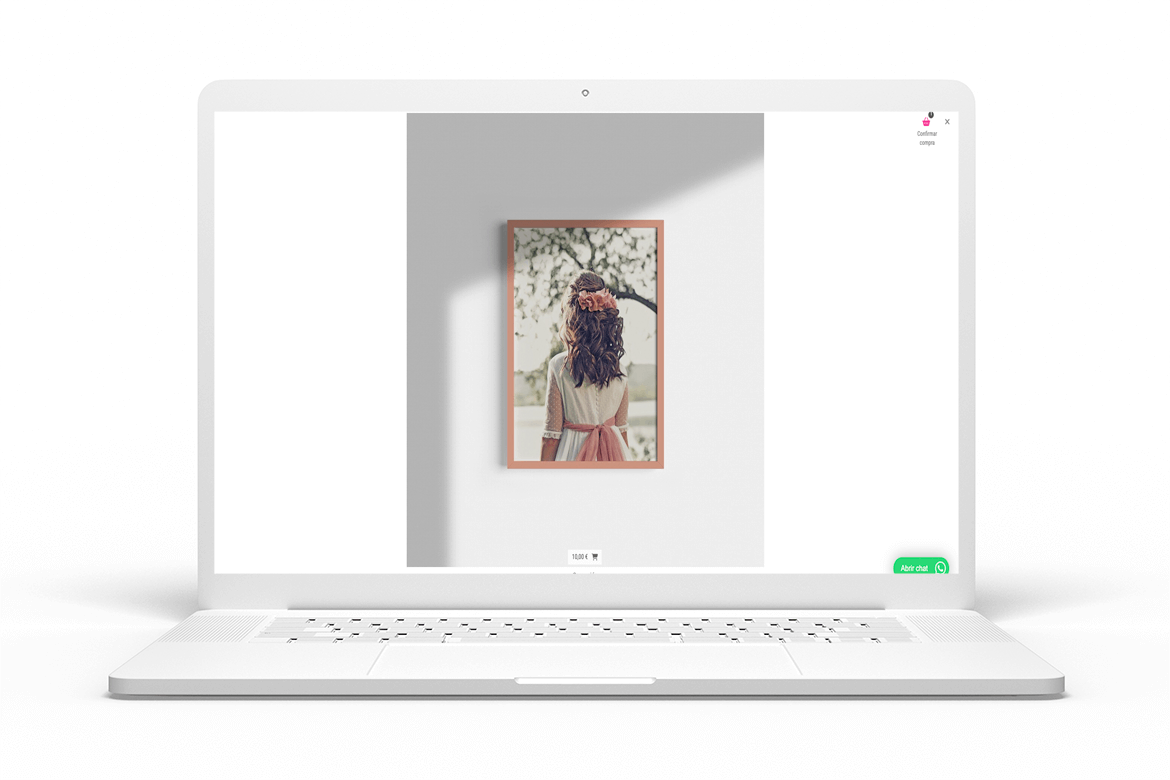
Arcadina’s client galleries are designed to make delivering photos to clients more professional, more convenient, and much more profitable. Instead of sending generic folders or links, you offer a private space where clients can view the session in high quality from any device and navigate through the photos smoothly, without getting lost or frustrated.
One of its great strengths is the multiple modes within a single delivery. This allows you to adapt the flow to each type of job: for example, the client can mark their favourite photos to help you finalise a selection, leave comments directly on the images, or download what they want without any complications. Everything is centralised and organised on the web , so you reduce random messages, questions and last-minute “can you resend that to me?” requests.
Another great advantage is that your clients will be able to purchase extra photos in digital format, request printed copies or professional-quality prints, and even purchase product packs that you have prepared for them in advance. This means that sending images to clients is no longer just a simple download: it becomes a more complete experience and a real opportunity to increase your sales without adding friction.
What’s more, these galleries reinforce your brand at a key moment: the end of the service. Careful digital delivery of photos raises the perception of value, improves the experience, and increases the likelihood that the customer will recommend you.
>> Create multiple photo galleries on your photography website
Turn photo delivery to clients into your best calling card
If you’ve made it this far, you already see it clearly: the way you deliver photos to clients can reinforce your professionalism… or tarnish the value of incredible work. Moving from generic links to a carefully curated digital photo delivery not only improves the experience, it also gives you back control of your business, makes selection easier, and opens the door to extra sales. In an industry where every detail counts, closing the deal is as important as taking good photos. Because when the delivery is up to par, the client notices, shares it, and recommends you.
If you are not yet familiar with this and the other business solutions we offer at Arcadina, don’t hesitate to sign up today. It’s free for the first 14 days.
We don’t want to end this article without first sharing with you an interview with Fran Ortiz, a wedding photographer who takes full advantage of sending images to his customers through private galleries.
>> Fran Ortiz, Arcadina Ambassador and renowned wedding photographer
And finally, we have one last question. How do you deliver photos to your clients? We’d love to hear from you in the comments.
Arcadina goes with you
Fulfil your dreams and develop your career with us. We offer you to try our web service free for 14 days. And with no commitment of permanence.
Arcadina is much more than a website, it is business solutions for photographers.
If you have any queries, our Customer Service Team is always ready to help you 24 hours a day, 7 days a week. We listen to you.